

Substack, I disagree...
A Misguided Way to Think About AI Collaboration

A Misguided Way to Think About AI Collaboration
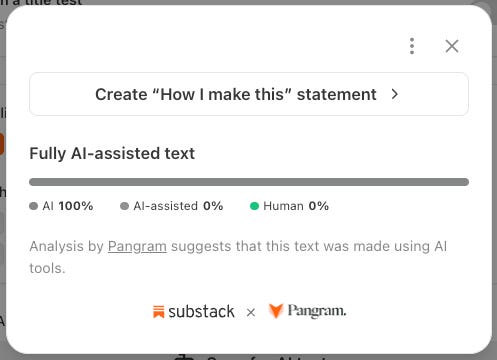
This is what Substack showed me after analyzing one of my drafts.
A neat little panel. A gray progress bar. A tidy verdict: Fully AI-assisted text. Beneath it, the percentages are almost comically absolute: AI 100%. AI-assisted 0%. Human 0%.
That last number is the one that does the work.
Human 0%.
Not “this text may have been drafted with AI assistance.” Not “this resembles patterns common in AI-generated text.” Not “the system is uncertain.” Just the clean bureaucratic absurdity of a machine declaring that no human being is present in a piece of writing whose ideas, arguments, examples, and final judgment came from a human being working with a machine.
I understand why platforms want to label AI-generated writing. Readers deserve to know whether they are encountering the work of a person or the output of a machine. Trust matters. Authorship matters. The internet is already full of low-effort synthetic sludge, and no serious writer should pretend that problem is imaginary.
But reducing a piece of writing to a percentage score labeled “AI” or “human” is a remarkably crude way to handle a serious question.
It treats authorship as if it were a purity test rather than a practice.
Writers have always collaborated with tools. We write with dictionaries, editors, research assistants, transcription software, search engines, grammar checkers, style guides, notebooks, libraries, conversations, and the accumulated voices of everyone we have ever read. A serious essay is rarely the product of one isolated mind producing immaculate prose from nowhere. It is assembled through attention, reading, conversation, memory, revision, judgment, and friction.
AI belongs inside that history, even if it also changes the stakes.
The real question is not whether AI touched the text. The real question is who is responsible for the thinking.
Did a person originate the argument? Did a person bring the lived context, the moral judgment, the examples, the claims, the taste, and the final editorial authority? Did a person decide what was true enough to publish under their name? Did the writer use AI as a collaborator, or did they outsource the work of having something to say?
That distinction matters.
A detector cannot answer it.
A detector can guess at stylistic patterns. It can notice certain forms of fluency, predictability, structure, or statistical regularity. It can say, “This resembles text commonly produced by AI systems.” Fine. That may be useful in some contexts. But it cannot tell whether the underlying idea came from a human conversation, a messy notebook, a client problem, a theological argument, a transcript, a decade of professional experience, or a midnight argument with one’s own conscience.
It cannot see authorship. It can only inspect residue.
That is why this approach risks training writers in the wrong direction. If platforms begin privileging “human-looking” text, then writers will start optimizing for whatever the detector thinks humanness looks like. We will get a new genre of performance: humans trying to sound less like machines according to a machine’s judgment of what machine writing sounds like.
That is not a victory for human creativity.
That is the machine becoming the editor while pretending to defend the human.
The irony is almost too neat. A platform uses an automated classifier to decide whether a writer has been insufficiently human, then invites the writer to produce a little compliance statement explaining the production process. Somewhere, Kafka is updating his Substack.
The deeper problem is that this mistakes the visible texture of prose for the integrity of authorship. Some AI-generated writing is bland, frictionless, and generic. So is plenty of human writing. Some human writers produce highly polished, structured, predictable prose. Some AI-assisted work may be deeply personal, intellectually honest, and rooted in real experience. The line between meaningful collaboration and lazy automation cannot be reduced to a dashboard.
Bad AI writing is not bad because AI helped make it.
It is bad because nobody is really there.
No judgment. No risk. No particularity. No lived pressure behind the sentences. No responsibility for the claims. No encounter with the world that could push back against the argument.
That is the thing worth resisting.
Not the presence of a tool, but the absence of a person.
A better standard would ask writers to disclose process when it materially matters, especially in journalism, scholarship, reporting, education, or fields where sourcing and authorship carry special obligations. It would encourage transparency without turning creativity into airport security. It would distinguish between AI as ghostwriter, AI as editor, AI as research assistant, AI as sparring partner, and AI as formatting tool.
Those are not the same practice, and pretending they are only makes everyone dumber.
The blunt “AI versus human” frame is especially unhelpful for people trying to develop responsible, mature collaboration with these systems. The best use of AI is not to let the machine replace the writer. It is to use the machine to sharpen the writer’s own thinking: to test structure, expose vagueness, suggest alternatives, summarize source material, find gaps, and help turn rough insight into clearer form.
That process can be lazy. It can also be rigorous.
The difference is not detectable by a percentage bar.
The difference is whether the writer remains accountable.
If I use AI to help organize an argument I have been developing through conversations, notes, client work, reading, and revision, that is not the same thing as asking a machine to manufacture a take because I need to post by Wednesday. If I reject half its suggestions, rewrite the rest, add my own claims, and publish only what I am willing to stand behind, then the important fact is not that AI was involved. The important fact is that the work still passed through human judgment.
That is what platforms should care about.
Not purity.
Responsibility.
The coming distinction will not be between writers who use AI and writers who do not. That line is already too simple, and it will become more useless over time. The real distinction will be between people who use AI to avoid thinking and people who use AI in service of deeper thinking.
One produces content.
The other produces work.
If platforms want to protect readers from synthetic sludge, they should focus on the signs that actually matter: sourcing, originality, disclosure, accountability, reputation, demonstrated expertise, and whether a writer has a real relationship to the subject. A cheap AI detector may feel like a shortcut, but shortcuts have a way of becoming the very problem they were built to solve.
The point is not that AI use should be hidden.
The point is that AI collaboration should be described honestly, not flattened into a purity score.
A serious writer using AI should be willing to say something like this: I use AI as a thinking and editing partner. The ideas, examples, judgment, and final responsibility are mine. I use the tool to clarify, challenge, organize, and revise, but not to replace the work of having something to say.
That is a more useful disclosure than Human 0%.
Because Human 0% is not an explanation.
It is a little digital scarlet letter produced by a machine that has no idea what actually happened in the making of the work.
And if we are going to build a healthier culture around AI, we will need better categories than that.